

Frequently Asked Questions
A compilation of the questions that we get asked frequently. If you are not able to find your query here, please feel free to reach out to us directly through out contact page.
What is Permaculture?Permaculture is an ethics-based systems design methodology, used to design regenerative human habitats - farms, settlements, homesteads, gardens etc. It draws inspiration from natural ecosystems, and incorporates whole systems thinking into the design process. Read more about Permaculture here.
What is regenerative design?This means going beyond sustainability towards regenerative approaches that not only prevent harm but actively heal the biosphere and actively build human relationships. The aim is to find ways to provide our basic human needs in a way that restores and enriches the living earth we live in. An example of this would be - digging an open well that can be recharged through infiltration earthworks to create a net-positive water system, rather than digging a borewell, which is usually extractive and not renewable.
What is ecological design?Ecological design is an approach to planning (especially of landscapes) that integrates human systems with ecological systems, ecosystem cycles, processes and components. It is a way to design spaces for all stakeholders - human and non-human.
Do you take up implementation?Yes, we take up implementation for masterplan designs, as well as key elements (like ponds, food forests, etc.). This engagement is either in a turnkey format, or through a tailored implementation guidance model. You can find out more about these here.
Where are you based?While our team is based out of Bangalore, India, our projects sites are across India, and we have worked on a couple of projects internationally as well.
How do I get started?Getting started is simple. Reach out through our contact form or schedule a call, after which we’ll walk you through the next steps and answer any questions along the way :)
What materials do you use in your projects?We work with what is available locally - either on the land itself, or in the vicinity. We try to focus on inputs that are generated from the land itself, and try to maintain circularity. This means that outputs from one element (for eg. manure from a cow shed) become inputs for another element (eg. veggie gardens).
What is your process?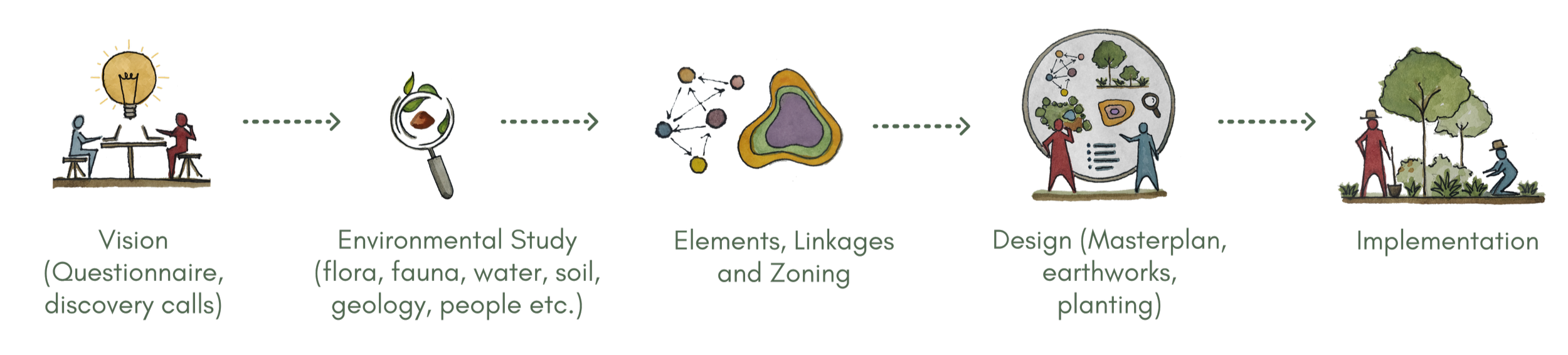
Can we visit your farm?We do not have our own farm, but you can visit our nursery (location linked here). If you’d like to discuss a project, we can set up a meeting at our studio. Please feel free to reach out through our contact page :)
Do you take up direct implementation of a pre-existing design?Our process generally follows the study > design > implement route, where we study and design for the site, before implementing it. However, we do verify pre-existing designs using our own observations and studies of the site.
What are your charges?Our charges vary from project to project, and are tailored to the client’s vision, the project’s scope, acreage, level of detail and so on. If you’re interested in working with us for a project, do reach out using the form here and we’ll be happy to get to know your vision / your land and take it forward from there.
How long will it take?This depends on the scale of the project, the clients’ vision, the complexity of the ecoregion / terrain and scope. Project timelines for design vary from 3 to 12 months, and implementation takes anywhere from 3 months to 2 years.
Do you offer surveying as a service?No, we do not take up contour surveys, since there are established experts for this specific service in most parts of the country. For guidelines on what to ask for in a contour survey, you can go through this post.
When is your next volunteer day?At the moment, we don’t conduct regularly scheduled volunteer days. However, if there is one planned, we will post it on our social media (Instagram, Facebook) and our website.
Do you sell plants?Yes, we have our own native nursery in North Bangalore - Ananas Native Nursery. You can find out more about it here!